
30 Years of the Wholesale Market: the Hedge Market
Download ReportBy Greg Sise, 23rd November, 2026
Energy Trendz Perspective - Issue 12
Our Executive Chairman, Greg Sise, looks back over 30 years of the wholesale market, in the fifth of a series of perspectives on the market.
2026 is a milestone year for the wholesale market and for Energy Link, because on 2nd September Energy Link was 30 years old and on 1st October the electricity market was also 30 years old.
This is the fifth in a series of articles that are a mix of perspectives on the market covering the last 30-odd years, focussing on key elements such as demand and generation, and also on Energy Link, the role that we’ve played, and how this has changed.
The first article looked at why we have a competitive market, starting with moves to reform the electricity sector in the late 1980s, through to the start of the spot market in October 1996.
The second article looked at how the market performed relative to why it was set up.
The third article looked at how demand has changed since 1996 and how it might change in the future.
The fourth article looked at how the generation mix has and is changing.
This article looks at the hedge market, which is part of the wider wholesale market, the role it is supposed to play, the role it has played, and where it is today.
I’ve looked forward to writing this article because it is the hedging activities of electricity market participants that over the years has created some of our best “war stories” concerning clients. I won’t be naming any clients, obviously, and I doubt that any will identify themselves in these stories. I’ve told the stories many times as they serve valuable lessons concerning human biases and limitations, and how these manifest in the wider hedge market.
Hedging and the hedge market are a challenge for most people to get their heads around. The basics are simple, but when we start thinking how to put a hedging strategy in place, it gets complicated very quickly.
I start by describing, as simply as possible, the hedge market as it is, and the role it plays in the wider market. Then I look at how it has performed relative to how it should perform, and where it is today. The war stories are scattered throughout.
Hedge Market - the Theory
The wider electricity market actually consists of five markets that interact with each other. Underlying everything is the spot market, through which all electricity that enters or leaves the wider grid must be traded.
The volumes are volatile, and the spot prices are more volatile still.
Generators are paid for their output at the relevant spot prices, creating volatile generation revenue. If spot prices are low, their revenue will be low, and they could be losing money.
Retailers buy electricity from the spot market to supply their customers in the retail market. Hence retailers’ costs are volatile, but their revenue is less volatile because they sell electricity to customers at stable retail prices agreed in advance. If spot prices are low, they make money but, if spot prices are high, i.e. if spot prices are higher than their retail prices, they lose money.
There are two other much smaller markets called the reserves market and the frequency keeping market, but they aren’t relevant to this discussion.
The risks of being a generator or retailer being 100% exposed to spot prices, are very high, so high in fact that the vast majority of market participants want to reduce their risk, significantly. If they are a generator, they can do this by having their own customer base, which provides a natural hedge for generation, but they can also do this by trading hedge contracts in the hedge market. Likewise, a retailer with no generation can reduce their risk by trading hedge contracts in the hedge market.
If I’m a generator, and spot prices are low, I would like an additional payment which would bring my revenue up to where it needs to be to allow me to cover all my costs. An option contract is a type of hedge contract that would achieve this: I would buy an option (if I could find someone willing to sell me one), and the option payment would be in proportion to the difference between the price I need and the low spot price.
If I’m a retailer, and spot prices are high, I would like an additional payment which would offset the high spot prices, and providing me with some margin on my sales to my customers. An option contract would again achieve this, but this time I would buy an option in which the option payment would be in proportion to the difference between the price I need and the high spot price.
In the NZ electricity market, option contracts are available, but they weren’t always. Even then, they are not the most common type of hedge contract, because they tend to be expensive: anyone selling you an option wants to be paid a substantial sum, known as the option premium, to make it worthwhile taking the risk of paying you out.
The most common hedge contract in NZ is the Contract for Differences (CFD), a type of ‘swap’ contract.
Looking at generation, I might be happy to agree with a counterparty (the other person I am hedging with) to swap payments around an agreed hedge price. If the counterparty is a retailer, this arrangement would work really well. Here’s how.
If the spot price is low, the retailer pays a sum to the generator which is the difference between the hedge price and the spot price. The generator is happy because they are better off than just being paid the low spot price.
The retailer has paid out on the CFD, but the hedge price is agreed so that they still make reasonable margin on sales to their customers.
If the spot price is high, the generator pays a sum to the retailer which is now the difference between the spot price and the hedge price. The retailer is happy because they are better off than having to pay the high spot price. The generator has paid out on the CFD, but the hedge price is agreed so that they still make reasonable margin on their generation.
CFDs are traded in the ‘over-the-counter’ (OTC) sector of the hedge market, which simply means they are negotiated directly between two parties, without recourse to an organised exchange.
If we understand the types of contract available and how we could use them to manage our risks, then the theory behind the hedge market is that generators and retailers will trade CFDs, or other types of contracts such as options, so they all preserve their margins and can remain in the market, instead of facing financial ruin when spot prices move against them.
ECNZ and the ESAs
In February 1996, Contact Energy was split out from the Electricity Corporation of NZ (ECNZ), which was split into Meridian Energy, Mighty River Power (now Mercury NZ) and Genesis Energy in April 1999.
Also in 1999, the Electricity Supply Authorities (ESAs) of the day were required to separate their energy and their lines businesses. Prior to this the vast majority of retail customers were supplied by the ESAs in their respective franchise regions.
Most of the ESAs had no generation of their own, so they needed hedging for their respective retail businesses. Some of the ESAs worked with buying groups mentioned in the first article in this series, and a few worked with Energy Link to develop and implement hedging strategies.
In any hedge transaction, the hedge price sets the price for both parties to the hedge, e.g. a generator and a retailer. The retailer might be prepared to pay a premium hedge price relative to being exposed to spot prices, like an insurance premium. The retailer wants protection from high spot prices, so if they assess the spot is likely to average $100/MWh, for example, they might be prepared to pay $105 to avoid taking the risk of having prices go to $500 in an extreme dry period.
We worked with the senior management team (SMT) of one ESA and developed a hedging optimisation model that allowed us to assess the trade-off between having more hedge cover versus the cost of the hedges. The SMT was eager to explore these trade-offs, and eventually settled on a hedge strategy that gave them about 80% protection from high spot prices. They took this to their Board, and the answer came back – we don’t want to take any risk. The ESA ended up hedging 100%.
That was a lesson for me to always take clients’ statements about hedging with a grain of salt, as their real risk preferences are not revealed until a hedging decision is made. Over the years, I started to quip that a risk (hedging) consultant is someone you engage so that you can put your hand on your heart and say “we got expert advice” when you go to the Board with your recommendation to hedge the way you planned anyway. That is quite unfair to many of our clients, who did and still do take our advice seriously, but it doesn’t always feel that way.

The hedge market in those early days was very active because there were over 25 retailers all wanting hedges from ECNZ and Contact Energy. Option contracts were sometimes offered if a party wanted them but in reality almost 100% of hedge contracts were the industry standard CFD.
Vertical Integration
But when ECNZ was finally split up in 1999, and the ESAs had to choose lines or energy, most of them chose lines, and thus commenced a ‘lolly scramble’ by the four large generators, along with Trustpower, to buy the ESAs’ customer lists. As I recall, the value of a customer in these transactions averaged in the hundreds of dollars, so there were large sums changing hands.
By the end of 1999, the five largest generators had achieved a high level of vertical integration, and owned most of the customers between them. If you have both generation and retail customers, then your net exposure to risk is low, so maybe you don’t need hedges? Even if you do need some, you need way less hedges than you would if you were just a large generator.
Thus were born the generator-retailers, or gentailers for short and at this point, the hedge market shrank dramatically, both the number of participants and the volume of hedge trading. With only a few large market participants, and relatively inflexible demand for electricity, the pressure to innovate and compete in the retail sector of the market reduced significantly.
From the mid-2000s, Energy Link has run a course called ‘Hedging Electricity’, currently presented by Paul Chapman, our in-house hedging expert, but I was the initial presenter. One day I had a class that included an electricity trader who was brand new to the role, having come from the financial markets. I explained to the class how a CFD works and how we combine cost or revenue in the spot market with hedge payments in the electricity market. “That’s not correct, Greg, it should be ….” this person kept saying. After further explanations and examples, the trader still wasn’t convinced.
This is something we’ve observed over the years, that even though traders from the financial markets are familiar with CFDs and a range of other hedge types, applying to electricity, with its true real-time nature and its delivery across a widespread grid, switching context can take time. And in case you’re wondering, I was right. Financial markets don’t have to deal with the spot price differences that we have across the transmission grid, which cannot always be hedged at the grid locations that you might like.
The lack of innovation in the retail market nevertheless created opportunities for new retailers to enter the market with novel offerings. For example, Electric Kiwi’s free hour of power, Flick Electric’s spot price plans, and Energy Club’s fixed non-energy, non-lines club fee, to mention just a few. But an independent (‘indie’) retailer paying spot prices needs ready access to hedges in quantity sufficient to meet their needs as they grow their customer base, and at a price that provides a margin between the price their customers pay, and the sum of the hedge prices they manage to attain in the hedge market, lines charges and the non-energy costs of being an electricity retailer.
Indie Retailers
The chart below shows the total ‘ICPs’ in NZ, with each ICP being a supply point for a customer. Some customers have more than one ICP, but ICP is a good proxy for the number of customers a retailer supplies.

This is especially true for indie retailers, those that are not owned in whole or in part by the big gentailers, as they tend to focus on growing by targeting residential and SME customers, where the vast majority of customers have just one ICP.
The total number of ICPs in NZ keeps growing, up 551,000 since 2003, but the total share held under the names of the big gentailers (‘Gentailers Direct’ curve), including Contact Energy, Genesis Energy, Meridian Energy, Mercury NZ and Trustpower has only increased by 114,000. Trustpower’s residential and SME customers went to Mercury NZ in 2021, and the company (by then renamed Manawa Energy) was purchased by Contact Energy in 2025.
The step change in 2023 is the purchase of Energy Online by Genesis Energy, which saw the transfer of 88,000 ICPs.
The ‘Started Indie’ curve is the number of ICPs held by retailers that started independent, and the ‘Still Indie’ curve is the number of ICPs held by retailers that started independent and are still independent today. As of today, 315,000 ICPs (13%) are held by the indie retailers, and the gentailers hold the other 87% either directly or through various brands.
But the gap between the Started Indie and Still Indie curves shows that hundreds of thousands of ICPs have, over time, initially been held by indie retailers until eventually being sold to the gentailers.

To get a better idea of the dynamics in the indie retail sector, the next chart shows the number of indie retailers that entered the market, and the number that are still in the market. Initially, the rate at which indie retailers entered the market was relatively low, maybe one or two per year.
But in 2014 this sector became much more popular. Now, if you’ve read the other articles in this series, you’ll know that demand growth stalled after 2006, but the industry kept building new generation through to 2014, which created a surplus of generation relative to earlier years. This, combined with a series of years of relatively high inflows for hydro generation, kept spot and hedge prices relatively low. Our hypothesis at the time was that new retailers felt it was relatively safe to start a new retail company: buy electricity cheap at low spot prices, and sell at prevailing retail prices, thus making a healthy margin.
This is a bit like buying shares while the market is going into a bubble, when it seems investors can only win, which is driven by a range of psychological factors including FOMO (fear of missing out), recency bias, anchoring bias, and overconfidence bias.
FOMO is often mentioned in the media, but the other biases not so much: recency bias causes people to attach excessive importance to recent trends and events, ignoring or underestimating the importance of longer-term trends. Anchoring bias is similar, and something that people new to an industry are susceptible to, as it leads to a person relying too much on the first information they get when making decisions, in this case the information is that ‘spot prices are low and relatively stable’. It’s like beginner’s luck, when your first go at a new game or activity just happens to go your way, and leads to you repeating the same strategy believing it to be the best approach.
Even experts can be guilty of overconfidence, if they’re not careful, but in the case of a new entrant this often arises when initial success leads to overestimation of one’s knowledge and ability.
Getting back to the market, in 2017 we had the first really dry period for inflows for several years, which caused spot prices to head upward rapidly.
We had a client during this period, a small but successful indie retailer, who came to us for hedging advice as they grew their customer base. While the lakes were still relatively full, they were looking for hedges in the North Island and we got several offers for them, one of which was priced as low as we’d seen for some years, and that we didn’t expect to stay around for long. Our client had a business partner, a local accountant, who he consulted about our recommendations. He came back with a worried look to say that the accountant had said, “No. It’s going to keep raining.” We were absolutely dismayed.
Long story short, about a month later it hadn’t rained, hedge prices had moved up, and they ended up getting hedges priced 14% higher than they’d been offered just a month earlier, that’s a big slice of margin to throw away when your experts were telling you to take the first hedges offered.
‘Sigh….’
At the other end of the spectrum, we worked closely with another small, growing retailer who had a brilliant business plan and was growing fast. They were a joy to work with because, having had some experience in the market already with a large gentailer, they wanted to be close to 100% hedged at all times, which kept us working hard to achieve just that. It was intense work, but we always knew they were protected from the extreme vagaries of the spot market.
Unfortunately, they took a well-deserved holiday for a few weeks and while they were away the hedge cover fell, at the same time as the gas market turned to custard for a couple of months, pushing spot and hedge prices higher. When they got back from holiday the market had moved so far that, despite being well hedged in most periods, their exposure to the high spot prices was more than they could fund, and they ended up selling their customers to a larger player.
The last chart above shows that leading into 2018, the rate at which new indie retailers came into the market fell sharply, to zero per annum initially, then recovered after two and half years to average two or three per year thereafter.
As of today, we have about 36 indie retailers, although most of them are quite small. The next chart shows the number of indie retailers that today have more than 1,000 ICPs (small), more than 5,000 ICPs (medium) and more than 10,000 ICPs (large).

After more than two decades of retail competition, we have only four large indie retailers – 2degrees (which started life as Switch Utilities), Pulse Energy, Electric Kiwi, and Nova Energy. Of these, both Nova and Pulse are small gentailers.
So, we have only two large indie retailers that do not also own or have access to some generation. Furthermore, indie retailers collectively have only 13% of the market, measured by ICPs.
In the second article in this series I looked at how the market performed relative to the original objectives for its formation, but I did not look at retail competition because that was not one of the objectives – back in 1994 the 29-odd ESAs were all retailers, so the large retailer group was large in number. But I don’t think we can look at the retail market today and feel there is enough competition: indie retailer aggregate market share is low and there are a small number of larger indie players.
If we want to understand the reasons behind this, we don’t have to look much further than the hedge market. Notwithstanding the propensity of new entrants to make poor decisions, if indie retailers had better access to hedges at the right price, I believe there would be more by now and their market share would be significantly greater than 13% in aggregate.
Hedge Market - the Reality
This was recognised a long time ago, which has led to many efforts over time to improve the hedge market, so we’ll have a look at some of these efforts. The first of these has consumed an extraordinary amount of time and resource but, in my opinion, has never satisfactorily resolved issues the indie retailers have with the hedge market.
In 2009, a Ministerial Review of the electricity recommended that the four biggest gentailers put in place by June 2010 a hedge market with standardised, tradeable contracts; a clearing house; low barriers to participation; low transaction costs; and market-makers (more on these later). Progress was to be assessed by June 2011.
The ASX had already launched NZ electricity futures contracts in July 2009, and was chosen as the market to meet these requirements.
In actual fact, the New Zealand Futures & Options Exchange, as it was in those days, listed NZ electricity futures contracts in November 1996, and there was a significant level of trading, or at least there was until the Electricity Industry Reform Act of 1998 required the ESAs to split their lines and energy businesses, and split ECNZ, resulting in most customers being sold to the five gentailers. At that point, trading dried up and the NZFOE’s futures contract was eventually de-listed.
Futures are a particular kind of financial instrument (contract) which are traded blind on an organised exchange, subject to strict oversight and regulation, so they are not traded in the OTC market. This being the case, anyone in the world who meets the ASX’s criteria can trade them. So, the theory goes, this attracts traders and speculators, which increases liquidity, which leads to more trading, which leads to greater liquidity, which improves the prices signalled by the futures market, which leads to futures traders offering CFDs to indie retailers because they can back the CFDs up with futures contracts. The retail sector blossoms….
I’d better define what a futures contract is. It’s like a CFD, but the counterparty is always the exchange, and instead of settling (paying out or getting paid) once a month during the term of a CFD, futures contracts are settled every business day. Let’s say you buy a CFD in January 2026 for the 2028 year, then you would not settle the CFD until just after the end of January 2028, and thereafter monthly through to end of the year.
But an equivalent futures contract purchased in Jan-26 would be settled every business day starting on the business day after you purchased it, using the daily futures price as the proxy for the spot price in a CFD. This means you could be paying out, or getting paid, all the way from January 2026 to end of December 2028.
If the market goes against you, you could be in trouble if you have to front up with lots of cash to settle a futures contract, months or years before you get the matching payments from, or to, the spot market.
So, one could hardly expect indie retailers to dive into futures. Instead, you would hope that more CFDs would be available to indie retailers, based on there being more traders in the futures market who would put together deals where they sell CFDs to indie retailers, which they would hedge in the futures market.
Unfortunately, the futures market didn’t really turn out the way that some expected it to. The first thing that was noticed was that it wasn’t very liquid. What is liquidity? A liquid market means the price on the day is readily available to anyone that wants to trade it, that the market can support the volume you want to trade, and that your trade doesn’t move the market price appreciably.
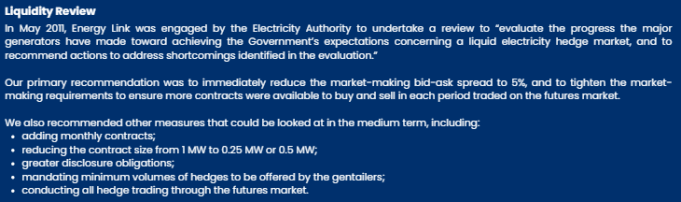
The ASX futures initially had market-making by the four largest gentailers, which required them to place bids to buy and offers to sell futures contracts with no more than a 10% difference between the bid and offer (asking) price, and to do this during a 20-minute window each trading day. In theory, market-making creates liquidity in a market by ensuring that traders can buy or sell when they need to, at a predictable price.
But the bid-ask spread, the difference between the bid prices and asking prices, remained stubbornly high, averaging 7% - 8%, and the trading volume was low.
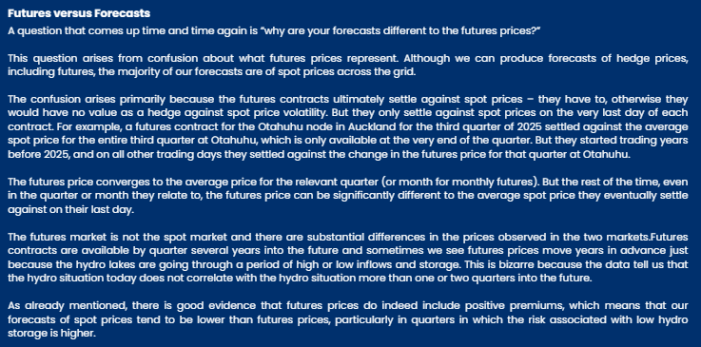
Late in 2011, the market-making bid-ask spread was lowered to 5%, and immediately the average bid-ask spread came down, and trading volume increased, as shown in the following chart: trading volumes increased (total GWh traded each day) and the ‘open interest’ also increased. Open interest is the total volume of contracts that are still outstanding, i.e. bought or sold, and still in play.
Trading volumes increased again in 2020 with further changes to market-making and as interest in the NZ electricity market increased among financial traders, both here and overseas.

But despite all the work done in improving the liquidity of the electricity futures market, over many years, indie retailers still complained of difficulty in obtaining the hedges they needed at a reasonable price.
New types of contracts emerged over time, including what are known as peak and super-peak CFDs. The peak CFD only hedges the daytime, and super-peak only hedges the morning and evening peak periods, when residential demand is highest and spot prices are most likely to spike. But even these contracts can be difficult for small indie retailers who have difficulty predicting the volumes they will purchase from the spot market to supply their customers (because they are growing, and often quite fast, at least initially).
In 2019 we developed a specification for a new type of CFD that we called “Flex-CFD”, which did not have a fixed hedge volume. Instead, the hedge volume changed based on the hedge buyer’s spot purchases, which would suit smaller indie retailers trying to establish a customer base because the hedge volume would always match their exposure in the spot market. In return for this flexibility, the retailer would pay a fixed premium in addition to the usual hedge settlements. We worked with the five big gentailers, including Trustpower, to refine the contract specification, and there was a willingness to price the new contract in response to requests from indie retailers.
Unfortunately, some of the best indie retailer candidates for this contract exited the market in 2020 and 2021, so the contract never traded. We did provide the Electricity Authority with copies of the specification, but it was never picked up. At the time, the emphasis was still on futures which, as I’ve already stated, was in my opinion misplaced.
The peak and super-peak CFDs were not always available, or came with requirements for bonds or credit guarantees, which made them prohibitively expensive in many cases. Or perhaps there were just very few hedge sellers, perhaps none at times, prepared to offer them to indie retailers at all.
A recent development, however, is an organised market for super-peak contracts, commencing January 2025, which just this year had market-making included, meaning that minimum volumes of super-peak contracts will usually be available. This is helpful for indie retailers managing their exposure to spot prices on their residential customer bases.
It is probably the case that having the futures contracts available supports participation in the super-peak hedge market, but the super-peak market-making is by the four big gentailers, who have always been the primary counterparties for CFDs. But in my view, if the Electricity Authority had moved much earlier on making hedges more available through measures like the super-peak market, and other non-futures contracts, perhaps even Flex-CFD, benefits for indie retailers would have been realised much sooner. There was always too much emphasis on futures, where indie retailers don’t do much hedging, and not nearly enough on OTC hedges.
To be fair to the Authority, the futures contracts arose as a recommendation from the 2009 Ministerial Review, which was undertaken by a panel of experts and agreed to by Cabinet. Working with the ASX, which already had futures for Australian electricity, was seen at the time as a way to get a quick win on this recommendation. Realistically, the best outcome would have been for the Authority to work with the ASX, but also to develop a complementary mechanism in the OTC market, e.g. super-peak contracts. But I guess good things take time, and sometimes a long time.
Looking ahead, I certainly hope the super-peak market will make it viable for the existing indie retailers to grow, and for new entrants to try their hand. We will know if it is working if we see the total share of ICPs held by the gentailers fall over the next two to three years, and for indie shares to increase. I believe 20% - 25% market share by indie retailers would be a sign that the retail market is really working.
We will just have to wait and see…
The sixth and final article in this series will look at what needs to change to get lower electricity prices and along the way I will mention the Lake Onslow pumped hydro storage scheme, which was referred into the fast-track approval process in March of this year.