A Leap Forward in Modelling Excellence
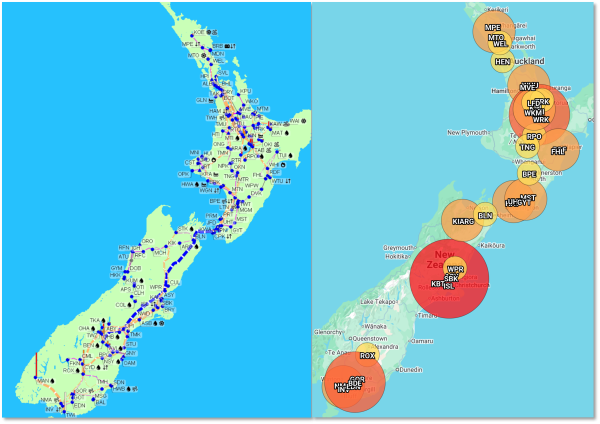
This month we took a major leap forward in our ability to model the wholesale electricity market with the addition of ‘SFT constraints’ into our flagship EMarket market model.
SFT constraints are also known as market constraints or N-1 constraints, and they refer to the loss of one circuit in the Transpower grid, and the potential for this to overload other circuits in real-time.
For example, if the southern hydro lakes are low, and a lot of power is heading to the South Island from the top half of the North Island, then if one of the core grid circuits from Tokaanu at the southern end of Lake Taupo to Bunnythorpe near Palmerston North were to ‘trip’ due to damage, then the circuit from the Rangipo power station to Tangiwai could overload. In this case, an SFT constraint would be added to the market dispatch to keep the load on these circuits below a critical level, potentially causing price separation on the grid.
Until now, we worked out the SFT constraints in another of our models, called EMO, and manually entered them into EMarket to do the long-term, detailed modelling.
But from now on, EMarket calculated the SFT constraints on the fly, which has many advantages including greater accuracy in formulating constraints, and also increases our modelling productivity in this area by at least one order of magnitude – what previously might take weeks can be done in hours.
Grid Congestion Outlook
One of the main beneficiaries of our new SFT capability in EMarket, is our Grid Congestion Outlook (GCO) which we currently issue twice per year. The GCO models the occurrence of SFT constraints through to 2045 in a base and high demand scenario, and indicates where the grid will need to be upgraded given the forecast of demand and new generation that we use in these scenarios.
The October 2026 GCO is currently in production, using the new SFT capability in EMarket.
The new capability now allows us to feasibly model more than one scenario, and gives us better information on a wider range of constraints that could cause grid congestion. The modelling is done at a resolution of one hour, across 97 sequences of historical hydro inflows, producing 849,720 one-hourly scenarios per calendar year. Moving from 2028 through to 2035 and 2045, we get a clear picture of where congestion develops and also why it develops, e.g. through addition of new generation or growth in demand.
We also plan, if we have time, to demonstrate how EMarket can now be used to estimate the benefits-based charges applying to Transpower’s customers for future grid upgrades, by modelling the impact of constraints in a defined region of the grid on spot prices in the region and beyond.
Energy Link Celebrates 30 Years
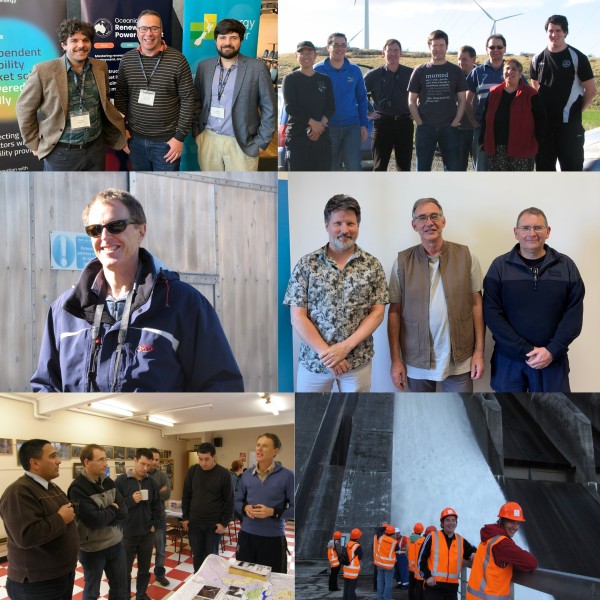
On 2nd September 2026, Energy Link celebrated its 30th anniversary.
Founded by Greg Sise in 1996, Energy Link was created to provide specialist market services and independent advice to electricity market participants. Alongside this, we developed the modelling and forecasting capabilities that remain at the heart of our business today, from our first Excel-based spot price forecasts in 1997 to the eighth generation of our EMarket model.
While the market has evolved significantly over the past three decades, our focus has remained the same, providing our customers with powerful insights into the future of the market, using leading-edge analysis to capture the latest information. Today, that mission is captured in our tagline: "Informing the transition to renewable electricity."
30 Years of the Electricity Market Article Series
On October 1st, the Electricity Market turned 30 years old. Reflecting on the past three decades, our Executive Chairman, Greg Sise, has written a series of perspectives discussing the following:
Why do we have a competitive market?
Over the past 30 years, how has the market performed relative to expectations?
How has demand for electricity changed over the last 30 years?
Three more articles in the series are yet to be published:
How has generation for electricity changed over the last 30 years?
The Electricity Hedge Market
How do we keep electricity prices low into the future?
Welcome Leonie
We are pleased to welcome Leonie Hitchman to the Energy Link team who has recently started her new role with us as an Energy Analyst.
Leonie joins us with an (almost completed) Master of Applied Data Science, after previously working within biomedical science research. Her role includes production of some of our wholesale market reports alongside exploring improved modelling approaches.
While this is her first role within the energy sector, Leonie is excited to be working in such a dynamic field with a strong real-world impact, particularly as Aotearoa continues its shift towards renewables.
Outside of work, Leonie enjoys getting outdoors, whether paragliding, hiking, skiing, biking or running, and also enjoys baking, reading and photography.