
Price Path - October 2026 Update
This edition includes several new scenarios to help explore how future electricity prices could change under different conditions.
New Base Case: Datagrid Data Centre
We have added an additional Base Case scenario that assumes the proposed Datagrid data centre is built in Southland. This allows us to assess how a large increase in electricity demand could affect future wholesale electricity prices.
The Datagrid data centre creates an initial increase in wholesale electricity prices as demand grows ahead of supply. This effect diminishes over time as new generation is developed and catches up with the additional demand.
New Climate Change Scenarios
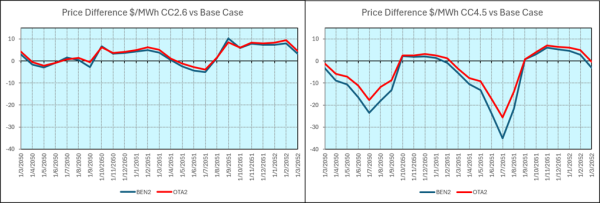
We have also introduced two climate change scenarios, known as Representative Concentration Pathways (RCPs). These scenarios project future greenhouse gas concentration pathways and their potential impacts on climate conditions.
We have selected RCP 2.6 and RCP 4.5 because they represent the most plausible climate futures over the forecast period and provide a useful range of potential outcomes.
Using our existing Scenario 6 (Base Case) as a starting point, we adjust historical hydro inflow patterns to reflect these different climate futures.
- RCP 2.6: A lower-emissions future where global greenhouse gas emissions decline significantly. In our latest Price Path, the resulting price effects of RCP 2.6 are small and indistinguishable from normal market variability.
- RCP 4.5: A moderate-emissions future where emissions stabilise over time. Here we see a more noticeable seasonal effect reflected in our Price Path. By the end of the forecast period, winter prices are notably lower than in the Base Case, while summer prices are slightly higher.
These scenarios help illustrate how changes in rainfall and river flows could influence hydro generation and, ultimately, electricity prices over the long term.
Price Forecast – October 2026 Update
Our October 2026 12-month Price Forecast continues to reflect the impact of high storage and inflows in the near term.
Looking ahead, electricity demand is expected to increase as major electrification projects at Fonterra and Glenbrook are realised.
These factors are important influences on the forecast electricity market outlook over the next 12 months.
Retail Market Update
The Electricity Authority is introducing draft retail market initiatives set to become progressively effective from 1 November. The changes include new billing requirements on retailers to prevent bill shock and make power bills easier to understand. Back billing will be limited to 6 months for large payments and routine checks will be required to ensure consumers are on the best plans for their needs.
New information-sharing protocols aimed at standardising information about retailers’ offerings also become effective in November. Under the new protocols (EIEP14A and EIEP14B) consumers, or their authorised agents, can request price plan and usage information from their retailer who must provide details in a standard format, so consumers, analysts and comparison services can make comparisons against other plans on the market.